
Most people treat the minutes before sleep as leftover time. Something to scroll through, something to let the day bleed into. But neuroscience has a very different account of what's happening in that window — and it matters enormously for anyone trying to shift their self-concept at a level that actually sticks.
The psychology of manifestation isn't about repetition volume. It's about timing. And the 20 minutes before sleep may be the single most leveraged window your brain offers for identity consolidation.
Why the Pre-Sleep Brain Is a Different Encoding Environment
As you approach sleep, your brain doesn't simply power down. It shifts. Specifically, it transitions from beta-dominant waking activity into alpha and then theta brainwave states — the same states associated with hypnotic suggestibility, loose associative thinking, and reduced prefrontal filtering. The prefrontal cortex, which acts as your brain's critical editor and self-consistency enforcer, begins to relax its gatekeeping. This is not incidental. It's the reason neuroscientist György Buzsáki at NYU has documented theta oscillations as the dominant rhythm during both REM sleep and the hypnagogic transition — and the rhythm most strongly linked to synaptic plasticity and new memory encoding.
What this means practically: the identity stories you hold in mind during this transition face less resistance. The brain's self-verification system — the mechanism William Swann at the University of Texas documented as actively rejecting information that contradicts your existing self-concept — quiets down. You are, neurologically speaking, more writable. Jan Born's lab at the University of Tübingen has repeatedly demonstrated that information encountered in the hour before sleep receives preferential treatment during subsequent slow-wave sleep consolidation. His targeted memory reactivation studies show that the hippocampus rehearses recently encoded material during slow-wave sleep, integrating it into long-term cortical storage. The implication is direct: what you place in your mind before sleep is disproportionately likely to be replayed and consolidated overnight.
This is distinct from the hypnagogic state itself, which I explored in a different context in this piece. What's specific here is the encoding window — the deliberate seeding of identity-relevant material before the brain enters its consolidation architecture.
FREE EMAIL STARTER PATH
Begin with Giselle’s 3-Day Starter Path
Three short practices to help you reflect, reset, and decide which next step fits you.
Get the Starter Path →Why Most People Get This Wrong
The most common mistake is using the pre-sleep window for affirmations. Repeating 'I am wealthy' or 'I am loved' in a detached, recitative way does not engage the systems that drive consolidation. Lila Davachi at Columbia University has shown that emotionally tagged memories — those encoded with genuine felt relevance — receive a dopaminergic signal that marks them for stronger hippocampal consolidation. Affect-neutral repetition doesn't generate that signal. You can repeat a phrase a hundred times in a flat internal tone and your hippocampus will treat it as low-priority noise.
The second mistake is consuming activating content — arguments, news, emotionally charged social media — right up until you close your eyes. This isn't a wellness platitude. It's a signal-to-noise problem. Matthew Walker at UC Berkeley has documented how pre-sleep emotional arousal disrupts the slow-wave architecture that consolidation depends on. If your nervous system enters sleep in a threat-detection state, the hippocampal replay that follows will prioritise threat-relevant material, not the identity material you want integrated. As I wrote about in this piece, the content of your emotional state at sleep onset shapes what your brain chooses to consolidate.
The 4-Step Pre-Sleep Identity Consolidation Practice
1. Create a 20-Minute Transition Boundary Set a phone-down point 20 minutes before you intend to sleep. This isn't about avoiding blue light — it's about clearing the encoding window of competing emotional content. Your brain will consolidate what it last processed with salience. You're deciding what that is. Lie down, dim the room, and let your nervous system begin its descent without further input.
2. Run a Specific Identity Scene, Not a Wish This is the critical distinction. Rather than stating who you want to become, place yourself inside a brief, sensory-specific scene in which you are already that person. Neuroscientist Donna Rose Addis at the University of Auckland has shown that episodic future simulation — imagining specific scenes with sensory and emotional detail — activates the hippocampus and medial prefrontal cortex in ways that generic intention-setting does not. The scene doesn't need to be long. Thirty seconds of vivid, embodied detail — the texture of the chair you're sitting in, the particular quality of ease in your chest, a specific sentence someone says to you — is neurologically more potent than ten minutes of abstract visualisation.
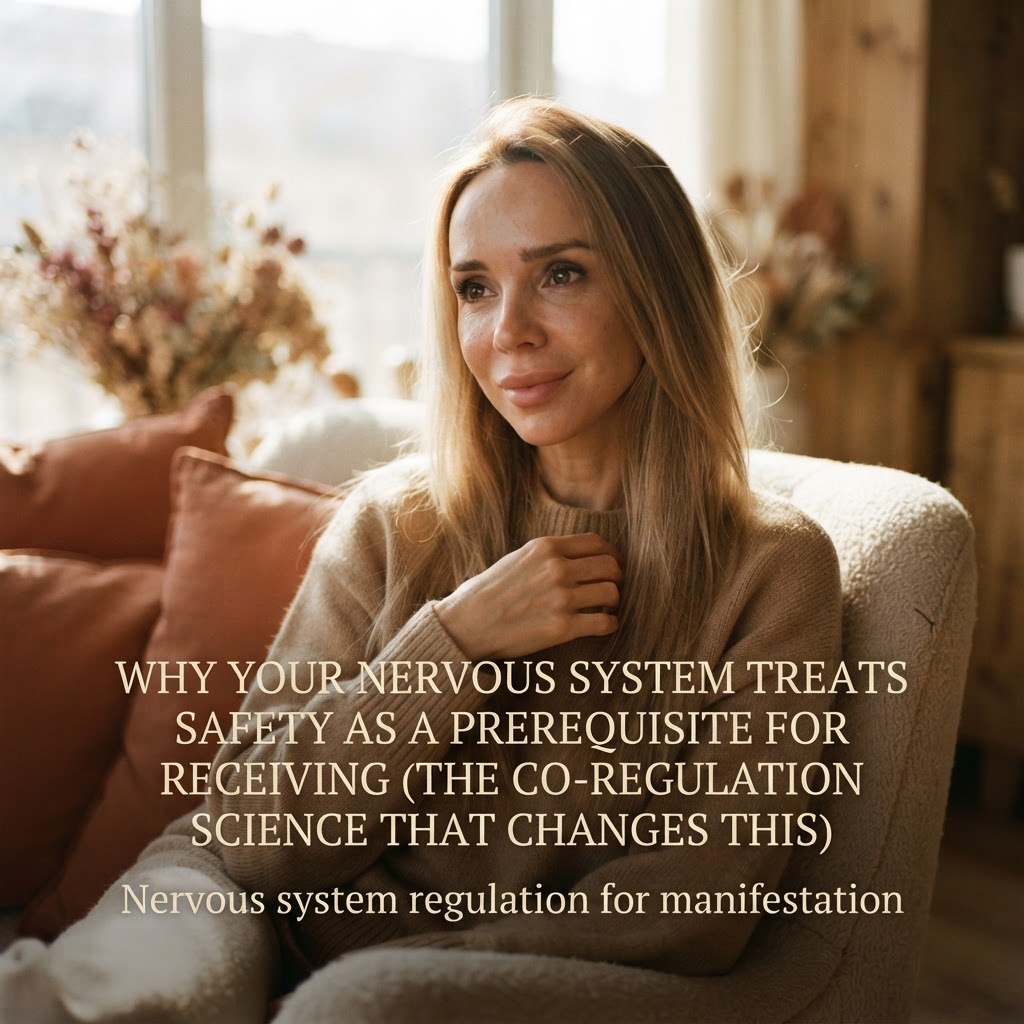
3. Anchor the Scene with a Somatic Marker Before the scene fades, place your hand on your sternum and take one slow exhale. Antonio Damasio's somatic marker research at USC demonstrates that physical sensations become linked to memory traces, allowing them to be reactivated as retrieval cues. You're giving your body a physical tag for the identity state you've just simulated. Over repeated nights, this gesture begins to function as a consolidation signal — a cue your body associates with the specific emotional-identity state you're reinforcing.
4. Release Outcome and Allow Descent After the scene and the anchor, do nothing else. Don't repeat the scene. Don't assess whether it felt convincing. Research on memory consolidation consistently shows that post-encoding rest — simply allowing the brain to be quiet after encoding — improves overnight retention. Psychologist Michaela Dewar at Heriot-Watt University found that even brief wakeful rest after learning enhances long-term recall by allowing the hippocampus to begin replay without interference. Sleep is the continuation of that process. Your job is to get out of the way.
Get Giselle's Weekly Insights
Psychology-backed manifestation insights, every week. Join 2,000+ readers.
Your Practice This Week
For seven consecutive nights, set a 20-minute pre-sleep window: put your phone face-down, run one 30-second sensory-specific scene of your chosen identity, place your hand on your sternum, exhale once, and sleep. If you want to build this practice inside a structure with accountability and community, the Reality Manifestation Circle opens its next cohort soon — you can join the waitlist at attractreality.com.